

6 / Future Scenarios: Economic Mobility, Workforce, and Inequality in California
Foresight practitioners use scenarios to help make future possibilities more vivid and tangible, immersing the reader in the particular details of a future world so that they can mentally situate themselves in what it would feel like to live there. Without scenarios, the signals, trends, and other research that underlie strategic foresight work can feel distant and abstract.
Scenarios can be used to center a group conversation in a positive and concrete picture of a future state so that stakeholders can pursue a shared vision for how to respond to that possibility, or mobilize action to avoid an undesirable outcome.
To imagine plausible future scenarios for economic mobility in California, we chose to interrogate the potential impacts of emerging workplace technologies by examining two critical uncertainties of the next decade: whether remote work will continue to grow as a standard practice or decline from mid-pandemic peaks, and whether technology will contribute to rising or falling inequality in the workforce.
At the intersections of these possibilities, we can immerse ourselves in speculative future scenarios to evaluate their plausibility and desirability. The future we actually arrive at will be greatly influenced by these new technological trends and the policies we enact to guide their development towards preferred futures.

Scenario 1
We’re all millionaires who ride the bus
Remote work becomes less common, technology promotes less Inequality
Companies in California realize the value of having workers in the office or workplace together—to learn from one another, to network, and to collaborate in real-time. Closer connections at work extend into relationships outside of the workplace, with workers of all wage levels living near their jobs. AI-enabled productivity gains cycle directly back to companies’ workers, prompting a rapid growth of the middle class that supports the agglomeration economies that emerge in well-balanced cities.
Long-standing race and ethnicity wage inequalities show rapid improvement, owing in large part to the fact that AI and automation are furthest along in low-wage industries. California’s companies realize that in-person work cuts down on the amount of free time its employees have to pursue education or other career-enhancing opportunities. With less physical and economic distance between coworkers, companies implement robust on-the-job learning programs to upskill its workforces.
An economy with a large middle class consisting of workers in offices and on campuses increases the proportion of workers who live close to their jobs. This scenario enables California to tackle some of its pressing climate issues: Reduction of energy-intensive mega-commutes, return of land use to conservation and water treatment rather than suburb and exurban housing, and targeted prevention measures to protect populated areas from natural disasters.
-
1990s
The decline of high-paying manufacturing jobs leads to an influx of immigrants to work in low-paying factories1991
The Tunnel Fire tears through Oakland, resulting in the third-largest death toll in the state’s wildfire history and prompting questions about how California manages urban-forest interfaces2018
California receives nearly 70% of all venture capital invested in the U.S., continuing a trend driven by tech industry growth -
Industry concentration
Many California regions are dependent upon one or two industries; diversification has worked well for some areasImmigration
Declines in immigration could be temporary or continueClimate
Wildfire mitigation is becoming increasingly difficult amid ongoing drought -
Current examples pointing in the direction of this scenario:
Stubborn Inequality
What: California’s large Latino population is still disproportionately represented in low-income brackets
So what: As AI is deployed in industries with high numbers of Latino workers (like agriculture), its impacts on those demographics could be profound in either direction.
=====
Filling Future Jobs
What: A PPIC study foresees larger job gaps for tech-related skills by 2025
So what: New types of training will be required to upskill workers, and could be designed to increase equity
======
Climate’s Economic Impacts
What: Climate issues have measurable effects on worker health and productivity.
So what: Rethinking where Californians live and work will be a critical lever for combating climate and influencing equity.

Scenario 2
Inviting California dreamers
Remote work becomes more common, technology promotes less inequality
The rapid development and deployment of both remote-working technologies and AI enables Californians to live and work wherever they want while the state’s productivity continues to improve.
In turn, California businesses and policymakers develop ways to attract workers to California via monetary incentives, housing subsidies, and unlimited leisure/vacation time. California’s workers choose to locate based on their desired surroundings, housing size and price, and family units. Workers from all over the world come to California to enjoy its natural amenities and the booming leisure industry.
Technology is put to use to maximize productivity while empowering and benefiting workers from all walks of life and in all regions. As a result, the state has money and a public appetite for large investments into critical problems such as climate, transportation, and housing.
A rise in remote work and equally-distributed economic growth from AI enables immigrants already residing in California to remain and contribute their expertise and skills while simultaneously enabling companies to find foreign workers to continue developing new technologies.
Remote work and an increasingly equal economy prompts many workers to decide to live in California for its natural beauty, but work for companies in other states or countries. California policymakers must make tough decisions about payroll taxes and other critical sources of the state’s income.
-
1989-1990
Undocumented immigration to California reaches a peak of over 200,000 people in one year1990s
Several California cities begin implementing living wage ordinances2020
California’s population declines -
Work Location Policy
Taxes and wage adjustments based on worker location will shape population center trendsPublic Will for Social Programs
Stigmatization of programs such as unemployment and welfare could limit moonshot endeavor feasibilityClimate
Currently desirable locations could become uninhabitable -
Current examples pointing in the direction of this scenario:
Moonshots for Homelessness
What: Project Homekey tries to mitigate homelessness by connecting residents to unused hotels.
So what: The public and private will to scale up new solutions to social issues will greatly impact California’s outcomes.
=====
Remote Immigration
What: Studies suggest California’s decline was exacerbated by rejected immigrant visas.
So what: Increased remote work could help immigrants secure work for California companies before moving to the state.
======
The Costs of Remote Work
What: Some companies adjusted wages for out-of-state remote workers during the pandemic, while others did not.
So what: The move to large-scale remote work will force new thinking on cost-of-living calculus for employers and employees.
Scenario 3
Champagne and shantytowns
Remote work becomes less common, technology promotes more inequality
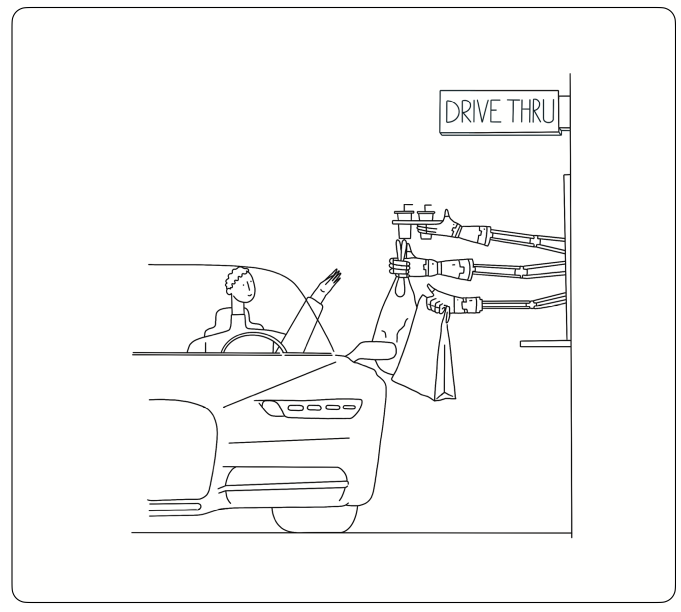
In a post-pandemic “return to normal,” businesses shun remote work in favor of in-person work, leading to a resurgence of agglomeration.
This comes at a time when AI and robotics reach major milestones, performing many physical and cognitive tasks affordably. These technologies have been developed and integrated with a strong focus on automation, rather than augmentation, and have disproportionately affected lower-wage occupations. Education and training have not facilitated skill development for lower-wage workers. A large portion of occupations become deskilled, low-wage, and scarce.
Californians live in mega-cities to attend in-person jobs. Corporate real estate and luxury housing are in high demand, and NIMBY attitudes proliferate. This leads to novel land development projects to increase low-income housing and create permanent homeless encampments along the coasts near major cities.
The demand for corporate real estate has led to a resurgence of corporate-owned and operated, mixed-use campuses in locations near major hubs. These towns offer subsidized housing to current and retired employees as a benefit, but lock workers into contracts that make mobility across firms almost impossible.
Sensing the encroachment of AI and other advanced technologies into their occupations, technology workers gather and organize. They refuse to build new technology that puts their job or occupation at risk while collectively bargaining for better working conditions.
-
1969
The Housing Element Law requires incorporation of adequate housing into development plans1978
Proposition 13 reduces property tax revenue for municipalities2018
California’s union membership rate hits a historic low of 14.7% -
Zoning Laws
Housing availability continues to challenge local governments to rethink zoningLabor Laws
Employee classification decisions will impact unionization rates (e.g., in the gig economy)Work Readiness
Workers will face adaptation challenges in the wake of increasingly-capable technology -
Current examples pointing in the direction of this scenario:
Floating Cities?
What: In 2019, UN-Habitat began investigating the plausibility of floating cities to alleviate housing pressure.
So what: Homelessness has risen steadily since the 1980’s, and poses a major threat to California’s future growth.
=====
New Company Towns
What: Housing issues have driven a renewed interest in “company towns” driven by private enterprise.
So what: Critics warn that vulnerable communities will lose their voice if the government abdicates its role in housing policy.
======
White Collar Unions
What: White collar organizations have seen a rise in unionizing, while low-wage work continues to see declines.
So what: As high-paid workers organize more effectively, income inequality is likely to be exacerbated.

Scenario 4
A real California exodus
Remote work becomes more common, technology promotes less inequality
The rising cost of real estate and growing proof that productivity increases can continue in a remote-first world drive companies to make more than 70 percent of jobs remote, allowing workers to live anywhere in the state.
At the same time, however, technology firms are able to source cheaper labor to develop algorithms and hardware than they could in the pre-remote world.
The result is that both lower-wage workers and tech workers who previously earned high wages see a decline in job availability and income, while executives and top managers see an increase in their pay.
Recognizing the move toward automation, workers with means take out loans to purchase robots they can operate from home and deploy their bots in various locations (“send your robot to work”).
The increasing capabilities of AI and the size of the now-global workforce drive a new form of wage and income polarization in which executives become so wealthy that they can live anywhere on Earth and beyond.
The growing population of elderly lower-wage workers lacks the means to support themselves. With nowhere to turn, they choose to commit crimes in order to be incarcerated, which provides a guarantee of food, shelter, medical care, and social activities.
The ballooning prison system services primarily the elderly, and by 2050, becomes the largest provider of eldercare services in the state.
-
2000s
Private space companies open up shop, renewing interest in private space travel and colonization2018
Residents aged 65 or older make up 20 percent of the population in 20 counties for the first time in the state’s history2019-2021
The Covid-19 pandemic drives a wave of remote work -
AI and Robotics
Predictions of AI and robotics displacing workers en masse have not yet come to fruition, but technology capability is increasingPandemic
Control: Future pandemics could further accelerate trends in remote workRetirement Funding
An aging demographic with undersized retirement savings presents a policy challenge -
Current examples pointing in the direction of this scenario:
Rising Automation
What: As of 2018, 14 percent of California’s industrial workers had been exposed to robots.
So what: Developing equitable ways to incorporate robots into the workforce will be critical to the success of Californians.
=====
Aging Populations
What: While California’s aging population is growing, 54% of private sector workers have not retirement savings.
So what: Without intervention, California’s vulnerable population is likely to grow as low-wage workers age out of the workforce.
======
The Real Exodus
What: While California’s population shrunk slightly in recent years, homelessness has increased in urban areas.
So what: If California doesn’t reverse trends, it will become mostly viable to those serving super-rich residents who can afford the house prices.